For senior leaders carrying more stress, overwhelm and pressure home than they ever let show

It isn't the pressure.
It's how you meet it.

Overwhelmed, quick to react, stretched thin at work and at home — and quietly aware you cannot keep meeting it this way.

The leaders who last — long careers, long marriages, long lives — are not the ones who feel less pressure. They are the ones who learn to work on their reactions, their interactions and their own regulation. Steady at the summit, and steady long after it. Do that work, and leaving well takes care of itself — which is exactly what the book is for.

Book a discovery conversation
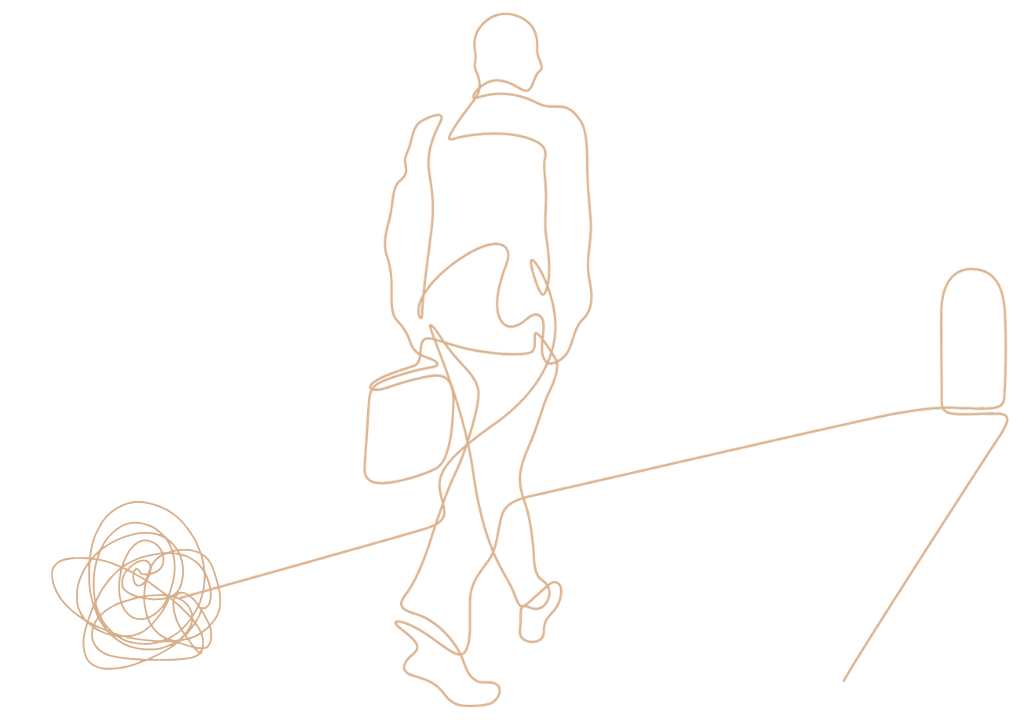
A single continuous line drawing of a man trailing a tangle of overwhelm as he walks toward an open doorway

"The people around you don't remember the pressure you were under. They remember how you were to live with while you were under it."

As seen on

ITV Daily Mail BBC Lorraine Show

Steady at
the summit

Left unchecked, pressure follows a predictable arc. The demands mount, the body braces, the mind narrows — and the very capability that carried you here quietly begins to cost you the things it was meant to protect.

Stress becomes overwhelm, and overwhelm — carried long enough — becomes burnout. It is rarely a failure of discipline or character. It is a nervous system that has run on adrenaline and endurance for decades and has forgotten how to stand down. The way through is not to push harder; it is to learn, at the level of the body, how to calm that system at its source.

01
Stress

The load is real and the response is normal — the body mobilises to meet the demand. Useful in bursts. Sustained without release, it quietly becomes the baseline you stop noticing.

02
Overwhelm

The system stays switched on. The fuse shortens, sleep frays, empathy has to be rationed. You hold it together where the world can see — and it leaks out exactly where you cannot afford it to.

03
Burnout

Eventually something gives — not because you are weak, but because no one ever taught you to switch the alarm off. This is where a nervous system left braced too long finally lands.

The Karteros Method steadies the system that drives all of it — so composure is no longer something you perform, but something you have.

Karteros is the work beneath the work: calming the nervous system so that pressure no longer runs the show. As the alarm quietens, the change is felt before it is thought — you meet the same demands as a steadier version of yourself.

More in controlSteady under load rather than braced against it — present, clear and unhurried when it matters most.
Less triggeredThe short fuse lengthens. You respond from choice instead of reflex, and the reaction no longer arrives before the thought.
True to your valuesYou behave in a way that sits with who you actually are — the same person at the summit and at your own front door.

If willpower were the answer,
you'd already be there.

You are one of the most disciplined people you know. Grit and sheer will carried you all the way to the summit. If the way through were simply a matter of trying harder, thinking differently or wanting it more, you would have found it long ago.

But this was never held in the mind — it is held in the body. A nervous system braced for years does not stand down on command, and no amount of insight or mindset work talks it down. That is why willpower quietly runs out of road: you cannot think your way out of a body that is still braced.

So the pressure has to go somewhere. When a system cannot discharge what it is carrying, it learns to numb it instead — to take the edge off just enough to keep going. It rarely looks like falling apart. Far more often, it looks like coping. These are some of the quieter ways it leaks out.

The busyness

You cannot stop working — not because it all genuinely needs you, but because stillness has become unbearable. A functional freeze dressed up as drive: always on, always needed, never quite here.

The extra drink

The one that takes the edge off the evening — and then, more often than you would say aloud, the next one after that. Not because you want it, but because the body has no other way to come down.

The screen

Another episode, another scroll, another late night you did not so much choose as fall into. Not rest, exactly — just enough distraction to hold the feeling at arm's length for one more evening.

The reach for more

Food, the phone, the next small hit of something — whatever reliably dulls what the body cannot otherwise put down. A quiet anaesthetic, repeated often enough that you stop noticing it.

Functional freeze is the quiet engine beneath it. To keep going under immense pressure, the system switches off the part of you that feels the stress — and, over time, you come to pride yourself on it. But numbing is never selective. In shutting down what hurts, it dims everything alongside it: the joy, the empathy, the pull toward the people you love. The dinner gets cancelled, the friend hears "not this week" again, and the reason always sounds like work — because the feeling of needing to keep working has quietly crowded out the room where everything else used to live.

None of this is a failure of character or a lack of resolve. It is a nervous system doing exactly what it was left alone to do. Name it honestly and the whole picture changes: the work is not to try harder, but to settle the system underneath — which is precisely what the Karteros Method is for.

The work
found me

Yvonne Williams

Yvonne Williams

Behavioural & mindset coach

In 2008, my husband had a nervous breakdown. The cause was work-related stress — decades of high performance in a demanding corporate environment that finally became too much to carry.

What I discovered in trying to help him was that the entire professional infrastructure — HR, medicine, occupational support — was poorly equipped for someone who could function at a high level in short bursts and then retreat into crisis.

I came to coaching through that experience. Before that, I had built and run a consultancy that employed doctors and nurses to advise businesses on workplace health — giving me an unusually clear view of how organisations handle, and mishandle, the human cost of high performance.

Since then I have worked with hundreds of senior leaders — helping them steady how they react and relate under sustained pressure, protect the relationships that the climb quietly erodes, and, when the time comes, leave well and reinvent the second half of their lives.

Behavioural and mindset coach
Ontological and somatic practitioner
Founder of a workplace health consultancy
Mediator
Coach to senior leaders since 2008

Three steps.
Seven stages.

The work itself is closer to home than the summit. It is learning to steady your reactions, repair your interactions, and regulate a system that has run hot for years — the quiet skills that keep a career long, a marriage intact and a life worth coming home to. That same work is also what lets you eventually leave well. The seven stages of that passage — from the summit to the open trail — are mapped in the book; the coaching gathers them into three movements.

1
Take Stock
Stages one & two — The Summit · The Descent

The peak of the career is not the end of the climb — it is the beginning of the descent, and most senior leaders have been so trained for the ascent that they have never registered they are now on the way down. We begin by honouring what the mountain gave — mastery, agency, status, the means to provide — before counting what it cost. The first aha most people meet here is quiet and exact: I built my identity, not my life. Leaving well is a separate skill from climbing well, and almost nothing in the corporate operating system has trained you for it.

The Summit The Descent The Four States Identity beyond the role Leaving well as a discipline Avoiding the panic exit
2
Come Home
Stages three & four — Base Camp · The Valley

Home has built its own civilisation in your absence — its own routines, hierarchies and quiet authority — and coming home is its own work: not a return to the centre of gravity, but a re-entry as a partner. Then comes the valley, where the silence is not a problem to be solved; it is an answer you have not yet learned to hear. This is the heart of the work and, often, the heart of the marriage — the asymmetry of the homecoming, the conversation neither person has yet had, and the slow difference between solitude and loneliness.

Base Camp The Valley The asymmetry of homecoming Solitude versus loneliness Turning toward What the silence contains
3
Exhale
Stages five to seven — The Waymarker · The Crossing · The Open Trail

Not every path forward is yours; you get to choose, and the choosing is the work. But understanding is not enough — the new self has to be practised into being, across language, emotion and body. The open trail has no summit, and that is the point: the work is not to find the next peak, but to become someone who can live well without one. This is where insight becomes embodied life — measured by the Litmus Test, expressed in your own voice, and built from purpose rather than performance.

The Waymarker The Crossing The Open Trail The Litmus Test Do — Be — Share Purpose without performance

Which state
are you living in?

The diagnostic that opens the descent. For decades you have cycled between Adrenaline and Endurance, mistaking both for being alive, and lost contact with Purpose and Enjoyment as states available on an ordinary day. The first question is simply: when did you last live in either?

Purpose
The destination

Operating from genuine meaning. Connected to something larger than the role, the salary or the status. Energy is sustainable and self-renewing.

Calm drive, generosity, creativity, presence, a sense of rightness

Enjoyment
The forgotten state

Genuine pleasure in the work and the people. Lightness and aliveness are present. Often the first state to disappear as seniority increases.

Laughter, curiosity, enthusiasm, time passing quickly, easy connection

Adrenaline
The corporate drug

Driven by urgency and achievement. Feels like high performance and is often rewarded as such. Over time it becomes the only register available.

Restlessness, can't switch off, thriving on crisis, emptiness between peaks

Endurance
The hidden state

Simply getting through. Often invisible to colleagues because high achievers have decades of practice masking it behind professionalism.

Sunday dread, flatness, counting down, going through the motions, "is this it?"

Clarity, simplicity and energy.
Applied at every stage.

Not every path forward is yours. These three questions separate a plan you might execute from a life you would actually live — held up against a new venture, and just as honestly against the marriage and the home.

Clarity

True clarity is not simply knowing what you want. It is understanding the beliefs that compete with what you want — the deeply held assumptions and unexamined fears that keep even the most intelligent people circling the same decisions for years.

"What are you telling yourself that conflicts with what you most want?"

Simplicity

Simplify does not mean easy. It means principled. Building a roadmap of values and commitments that you actually adhere to — a structure that holds your next chapter without constraining it.

"What structure would support who you are becoming — not who you have been?"

Energy

Flow. Cup full. Lost in purpose. Joy used here as a navigational instrument — not a reward for when everything else is done, but a signal pointing toward what is true.

"Is your cup full? When did it last feel full — and what was present then?"

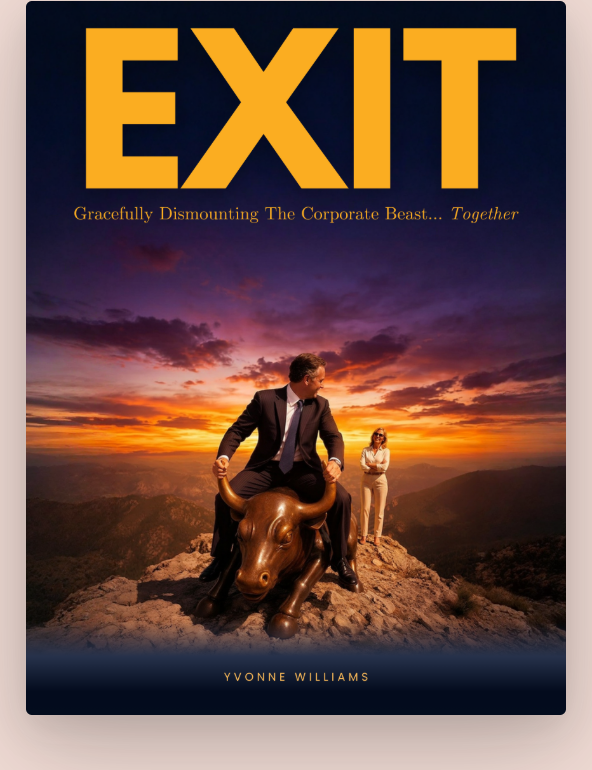
EXIT — The guidebook for dismounting the corporate beast, by Yvonne Williams

EXIT

The guidebook for dismounting the corporate beast

For every career climber, there comes a time when the thought of dismounting the corporate beast shifts from a distant murmur to a looming presence.

Whether driven by personal choice or forced by circumstances in a world reshaped by AI and workforce reductions, the question is no longer if, but when and how.

Dismounting the corporate beast is not just a career transition. It's a profound personal transformation — a descent from the peak of one's professional identity into the unchartered territory of rediscovering who you are, not just what you do. A journey that demands a shift from the leadership mindset of the climb to the partnership mindset waiting at base camp.

Through a powerful framework and thought-provoking prompts, EXIT invites career climbers to examine their climb — the ways in which the pursuit of doing and leading may have overshadowed the importance of being and partnering. It guides them to embrace humility, to rediscover the value of following as well as leading, and to envision a new chapter focused on presence rather than performance.

Crucially, EXIT recognises that this mindset shift is the key to a successful reintegration at base camp. It opens up space for honest, humble conversations about the climb's impact and the hopes for the future — providing tools for rebuilding connection, trust, and a shared vision for the next chapter. A chapter of partnership.

The journey unfolds across seven stages — the Summit, the Descent, Base Camp, the Valley, the Waymarker, the Crossing, and the Open Trail — each with its own terrain and its own work.

For the career climber ready to dismount the corporate beast and fully embrace the partnership of life at base camp, EXIT is the map they've been searching for. The trail ahead is yours. Walk it well. Begin.

If you want to work through this yourself, EXIT is your starting point. If you want a guide alongside you for the descent — that is what the coaching is for.

Join the waitlist

The trail ahead is yours. Be first to know when the map is ready. One message when it matters. No noise before then.

A discovery conversation.
No obligation. No agenda.

One unhurried conversation to explore where you are, what this work offers, and whether there is a genuine fit.

Book a discovery conversation All conversations are entirely confidential