Altitude Scale
A way of noticing two things as they happen: what you are telling yourself, and how it is landing in your body.
The two always travel together. Change the sentence and the body shifts. Settle the body and the sentence changes. Most leaders have only ever worked on the first.
Nobody is a level. Everyone moves between them, often several times a day. It is not a score and it is not a diagnosis. It is a map for noticing where you are, and for finding your way back.
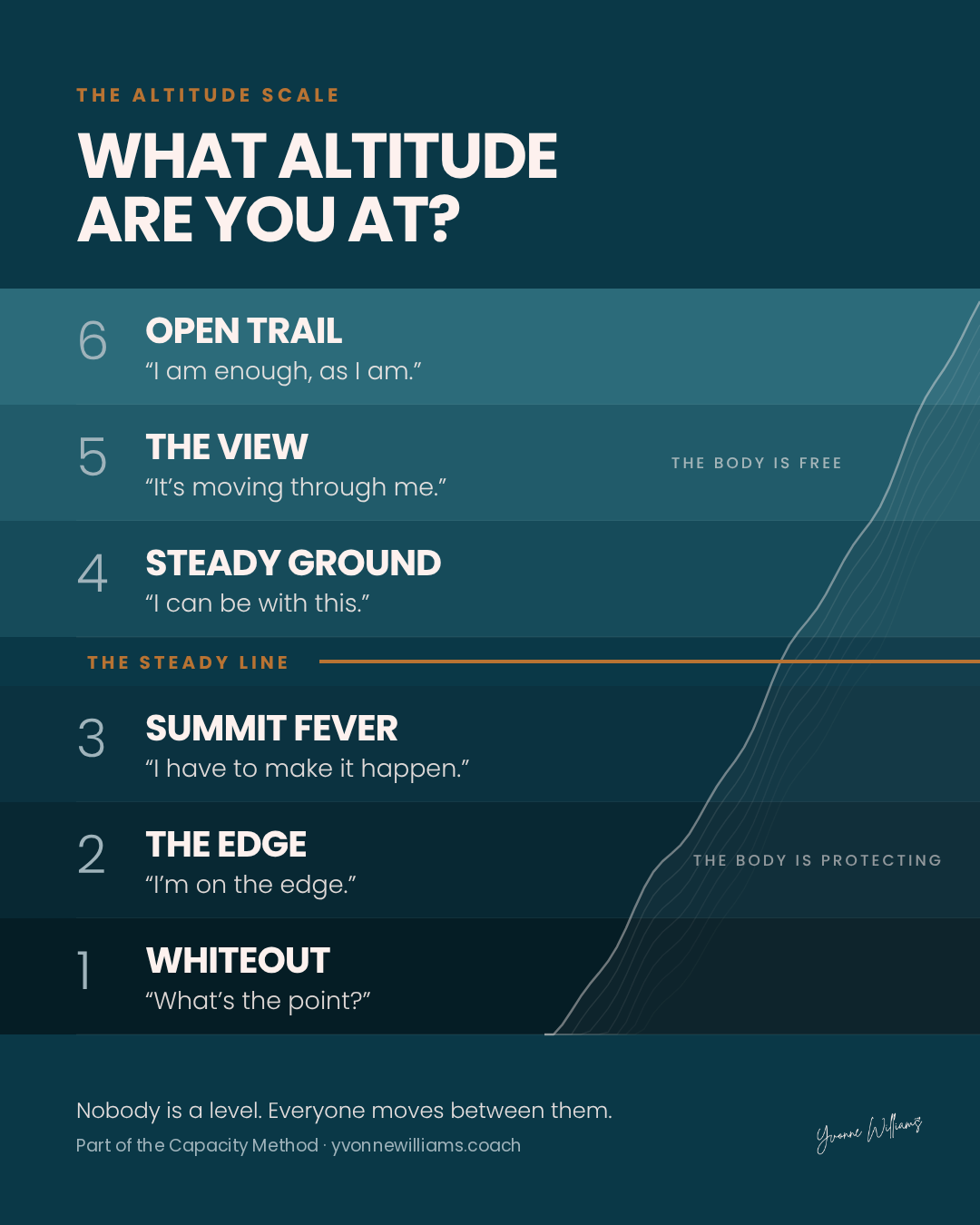
The six levels
Level 6
“I am enough, as I am.”
You no longer need the title to know who you are. Life is lived as yourself, not as the role. What you give, you give from fullness rather than from empty.
At home: fully there. The husband and father you always meant to be.
Level 5
“It’s moving through me.”
The climb has done its work, and there is space to sit and take in the view. Momentum without force. Easy, alert, energised without being wired.
At home: laughter again. The person people used to know comes back.
Level 4
“I can be with this.”
The system has settled and the brake works. Breath low and slow, feet on the ground, shoulders down. Able to feel difficult things without being thrown by them.
At work: clear decisions under pressure. Able to listen.
The Steady Line
Below it, the body is protecting. Every decision, conversation and evening at home costs more than it should. Above it, the body is free: steady enough to think clearly, feel fully and choose.
Crossing it is not about trying harder. It is about giving the body enough evidence of safety that it lets go.
Level 3
“I have to make it happen.”
The mountaineering term for climbers who keep pushing for the top long after it is safe. The accelerator, flat out: wired, restless, short on sleep, the mind already in tomorrow’s meeting.
Organisations reward it, so it feels like the top. It is still below the line. It is why “I am successful” can feel as tight as “I am tired”.
Level 2
“I’m on the edge.”
Braced and holding on. Still functioning, often brilliantly, while underneath everything is held very still. Jaw set, shoulders up, breath high and shallow. Sunday-night dread.
Most people would call this resilience. Holding on is not the same as being steady.
Level 1
“What’s the point?”
In a whiteout you cannot see which way is up, so you stop moving. Heavy, flat, tired in a way sleep does not touch. Present in body, absent in mind.
If this is where you are, start with your GP. Coaching can work alongside that, never instead of it.
The six checks
Everyone needs to feel safe, alive, that they matter, connected, growing and useful. Every leader meets those needs every day. What changes as you climb is how you meet them.
Below the line, you meet them by pushing, controlling and proving. Above it, from steadiness. Six questions show you which it is.
1 · Safety
Below the lineControl. Overwork. Checking the overnight markets at 6am.
Above the lineAn inner steadiness that holds, whatever the market does.
Settles at Steady Ground
2 · Aliveness
Below the lineAdrenaline, crisis, the drink to switch off.
Above the lineCuriosity, play, a screen-free Sunday.
Settles at Steady Ground
3 · Mattering
Below the lineThe title, being needed, pride.
Above the lineWorth that doesn’t depend on the role.
Settles at The View
4 · Connection
Below the lineApproval, performing, withdrawing.
Above the linePresence. Being loved, and loving well.
Settles at The View
5 · Growth
Below the lineThe next target, the next hack, the white rabbit.
Above the lineLearning that renews you rather than drains you.
Settles at Open Trail
6 · Giving
Below the lineSacrifice that looks like martyrdom: “everyone needs me.”
Above the lineGiving from fullness.
Settles at Open Trail
They settle in order. Safety and aliveness come first, on Steady Ground. Mattering and connection follow, at The View. Growth and giving come fully alive on the Open Trail.
How to use it
Ask yourself the question, and answer in one word: the name of the level. Not why. Not what to do about it. Just where you are.
That is the whole practice to begin with. Noticing without judging is the habit everything else is built on, and it is the one most leaders have never been taught.
Every Monday I write one letter about how leaders build the capacity to stay above the line. It ends with the same question.
The Altitude Scale is part of the Capacity Method, developed by Yvonne Williams. This is coaching and psychoeducation. It is not therapy and it is not medical care. If you are in crisis or at risk, contact your GP.