Capacity · Neurosomatic coaching for founders, CEOs and directors
Your days aren’t long enough. Your mood is volatile, your tolerance is low, and nothing happens quite as fast as you hoped. So you end up frustrated, and short with the very people you are doing it all for.
You know what you are building and how it is meant to look. The day keeps landing somewhere else, and there is no way back to steady while you are still going after it. That is what stress is.
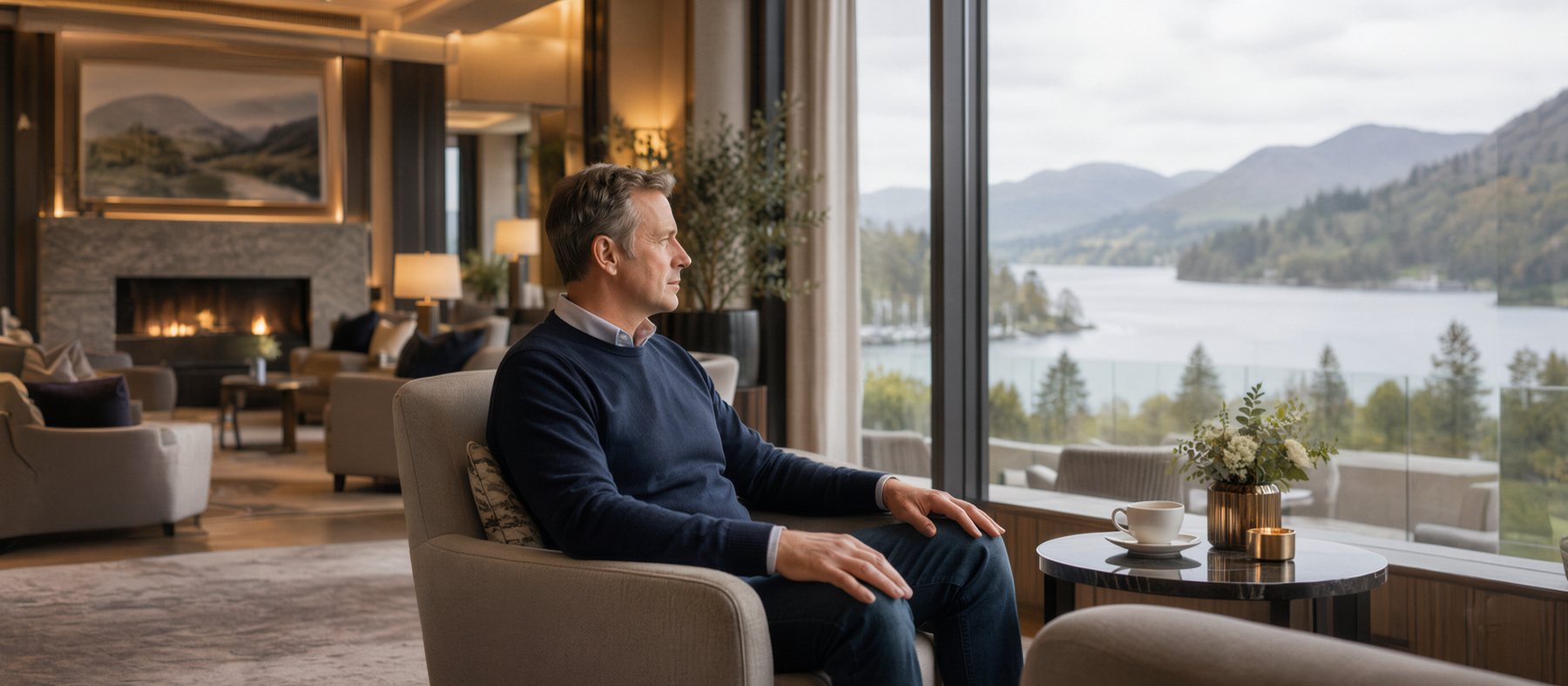
Come and spend twenty-four hours in the Lakes, away from the busyness of your world. Long enough for some radical self-inquiry, to solve what your own thinking has not solved so far.
Your assistant and your partner have a dedicated number throughout, monitored for the whole twenty-four hours. You are not out of contact. You are out of reach of everything that is not an emergency.
01 · The gap
You know who you want to be. The leader. The husband. The father. There is that man, and then there is the one who walks through the door at seven. The distance between those two is what stress actually is.
You know what it looks like from the inside. Tired all day and then wide awake at three. Running on autopilot, and some days you could not tell me what you did. Coming home like a bear with a sore head, and then not being able to cope with the noise once you are in it. Habits you do not like and cannot seem to put down.
It did not happen in one decision. It was the fifteen minutes late, the call taken at bath time, the promise quietly renegotiated. Each one affordable on its own. The account empties anyway.
None of that is weakness.
You have not run out of discipline and you are not failing at something other people find easy. You have been solving the wrong problem, carefully, for a very long time.
02 · The field
Resilience is the push. Rising to the thing, and keeping your head while it lasts. You are good at it. You have been praised for it for thirty years, and it is probably on your appraisal somewhere.
Here is what it cannot do, however much of it you have. It cannot stop you working more than you meant to. And it cannot stop you being in the room at home and absent in it.
Capacity is the ability to move through every state your nervous system goes into, and come back to steady. It is the whole cycle, not just the push.
In mind, emotions, body and spirit. Those are the four modes you run in, and the cycle has to complete in all four or it has not completed.
Resilience is the first two. The man who prides himself on it never comes all the way down. That is not a character flaw. It is a system that was taught to switch on and never taught to switch off.
Why reading about it has not moved it
You have read the books. You have done the courses, probably more than one, and some of them were good. You came out with better language for it, and by Wednesday nothing had moved.
That is not a failure of the books. The brain is where the conversation happens. It is not where the decisions get made.
So twenty years of work went into improving the quality of the conversation, in a room that was never running the place. Clear thinking is a physical event. Your body is holding the other half of it, and until both halves are worked together, insight keeps evaporating.
That is what neurosomatic means. Most coaching takes the first half only, which is dialogue. The whole system includes the body.
Four findings sit underneath this work. Each one is real, and each one has a limit worth knowing.
The cost builds when it fails to switch off, which is the part nobody trains. This is why the coming down matters more than the going up.
McEwen, New England Journal of Medicine, 1998. Allostatic load.Even mild uncontrolled stress impairs the prefrontal cortex and hands control to older habit circuits. It reverses when the stress eases. Which is why you are not stupid at four o’clock on a bad Thursday, and why you cannot think your way out of it in the moment.
Arnsten, Nature Reviews Neuroscience, 2009.Stress plus rest equals growth. Leave out the rest and there is no growth, only load.
Stulberg and Magness, Peak Performance, 2017.It is called the window of tolerance. It is a teaching model rather than a tested construct, and I use it as one, because it describes what men in these roles report with unusual accuracy.
Siegel, The Developing Mind, 1999.Research suggests all of this. None of it proves anything about you. The work is finding out which part of it is true of you, which is what the twenty-four hours is for.
03 · Where you are
Seven places a leader operates from. Almost everyone recognises himself in one of them inside a minute.
Below the line, the body is protecting. Above it, the body is free. Most people would call The Edge resilience.
Nobody is a level. Everyone moves between them, several times a day. It is not a score and it is not a diagnosis. It is a way of knowing where you are standing before you decide what to do about it.
04 · Why it happens away
This is the part that gets misunderstood about going away. It is not the scenery, and it is not a break.
You are not separable from the environment you sit in. The office, the commute, the kitchen at half past seven, the phone face down on the side. They are not the backdrop to how you operate. They are part of how you operate, which is why a quiet weekend does so little. You are still in range, and your body knows it.
So the work happens out of reach of both of them. Far enough that nobody can get to you and you cannot get to anything. The phone goes into a box on arrival. That is usually the first time in years the system has had no reason to brace, and clients tell me they slept more deeply that night than they had in a very long time.
That is the mechanism. The Lake District is simply where it is far enough.
05 · The twenty-four hours
A Faraday box is lined so that no signal reaches the phone. Not face down on the table, not switched off in a drawer where it is still three feet away and you still know it is there. Actually out of reach.
Before you travel, your assistant and your partner are given a dedicated number. Someone is on it for the whole twenty-four hours: my support during the day, and me overnight. Anyone who genuinely needs you can have you within minutes. Nobody else can reach you at all.
That is the part people underestimate. You are not out of contact. You are out of reach of everything that is not an emergency, which turns out to be almost all of it.
06 · Afterwards
The twenty-four hours is not a taster, and the three months after it are not a shortened programme.
Ordinary coaching is an hour somewhere in a week that is already full. You arrive from one meeting and leave for another, the first ten minutes go on catching up, and whatever you reach has to survive on its own until the next one.
This is twenty-four hours with nothing else in them. No phone, nobody to get back to, and the whole of it pointed at what is actually slowing you down. Then three months of keeping it moving while the system still remembers what settled felt like.
A check-in with me each week if you want it, forty-five minutes, booked by you when you need it, Monday to Thursday, to mark your progress and take the learning further. WhatsApp me any time in between, and I will reply within twenty-four hours. And a short daily self-accountability log, which I suggest you keep going long after the three months are done.
Included: the car from the station, lunch on arrival, your room for the night, dinner and breakfast. You get yourself to the station. Everything from the platform onwards is mine.
You will stay at one of my preferred hotels near Lake Windermere.
Some people carry on working with me once the three months are done. That gets decided then, not now.
07 · Who this is for
Also the man building something at four million who is still working the way he worked at four hundred thousand, and has started doing the arithmetic on how long that lasts.
The size of the business is not the point. The question is whether the way you are running yourself has started to cost more than it returns, at work and at home.
This asks for radical self-inquiry. Not a workshop, not a framework you can take notes on and implement later. Sitting still with the questions that haunt you, in front of someone who will not help you change the subject.
If what you want is a tactic for getting more out of the same way of operating, I am the wrong person, and I will tell you so on the call.
It is also not for anyone in crisis. If that is where you are, your GP first, and this alongside it rather than instead of it.
08 · Who I am
I started in corporate in the 1990s, at BUPA, running national occupational health programmes for large employers and leading clinical teams of around a hundred people. Much of the FTSE was on those programmes, with well over a million employees between them.
Then I built my own occupational health and wellbeing business and ran it for fifteen years. It began as me, a full-time nurse and a part-time doctor, funded entirely by me, and grew to a team of more than a dozen serving household names. A great deal of that work was stress.
I am not a clinician. I employed them.
Seventeen years of coaching since, most of it with leaders at the top. For years I worked with mindset alone. It took people a certain distance and then stopped, and I could not explain why an insight that landed in a session had gone by Tuesday. The body was the missing piece. That is the whole of why I work the way I do, and it is why capacity, rather than resilience, is what I teach.
Qualified in somatic coaching, NLP, and life and business coaching. Currently studying ontological coaching and fascia work.
09 · The investment
The Altitude Retreat is £15,000: twenty-four hours in the Lakes, then three months of working together on whatever you need to focus on, across all ten areas of your life.
Until 31 December, it is £7,500.
WhatsApp me any time, and I will reply within twenty-four hours. A forty-five-minute check-in each week if you want it, booked by you, Monday to Thursday. Then, if you want to keep going, we talk about extending.
No date is fixed when you book: once your place is confirmed, I work with my preferred hotels near Lake Windermere to find a date that suits you.
10 · Questions people ask
Three months to turn what you found into habit. WhatsApp me any time and I will reply within twenty-four hours, book a forty-five-minute check-in each week when you need one, Monday to Thursday, and keep a short daily self-accountability log. Without that, the habits you already have are waiting for you the moment you get home.
Almost nobody can, which is the point. You are not uncontactable. Your assistant and your partner have a number that is monitored the whole time, by my support during the day and by me overnight. What you are out of reach of is everything that is not an emergency, and that turns out to be almost all of it.
No date is fixed when you book. Once your place is confirmed I work round your diary to find twenty-four hours that suit you.
No. It is coaching and psychoeducation. I will never advise you on medication, and if you are in crisis or at risk the right first call is your GP. This can sit alongside that.
That is the most common thing I hear, and it is usually true rather than a failure of effort. Dialogue on its own reaches a certain depth and then stops. This works the body and the mind together, which is why what happens in the twenty-four hours is still there in week six.
Not at this stage. The retreat is for the person at the top, because that is where the work makes the most difference and because the three months are built round a diary like yours.
The place is non-refundable, because the costs happen whether or not you attend. If you cannot come, you have a four-hour Zoom intensive and six weekly sessions in place of the retreat, to be used within three months of your original date. The full terms are linked at the foot of this page, and the tick box is on the checkout.
11 · The next step
Book a one-hour coaching session first. Bring the thing that is stopping you, and we’ll start working on it. It’s a real session, so it’s paid.
If the retreat is not the right thing for you, or not the right time, I will say so.
This is coaching and psychoeducation. It is not therapy and it is not medical care, and I will never advise you on medication. If you are in crisis or at risk, contact your GP, and we can work alongside that.