
№002
You don’t have a time problem
There’s a gym session in your diary on Thursday at six. It’s been there for eleven weeks. You’ve been four times.
Here’s the thing nobody selling you a time-management system will tell you. You don’t have a time problem. You have a capacity problem.
You already know what to do. You’ve read the books. You could probably run the session on blocking out the diary, slides and all. Knowing was never the problem. Doing it on a Thursday is.
Here’s why. The part of your brain that turns knowing into doing sits just behind your forehead. It holds the plan, says no to the distraction, and changes course when it should. Amy Arnsten, a neuroscientist at Yale, has spent decades studying what pressure does to it. Even mild stress, the kind you feel you can’t control, knocks it offline, and fast. The controls pass to older, quicker parts of the brain that run on habit.
Under load, you don’t run on what you know. You run on what you’ve rehearsed. And at six o’clock on a Thursday, what you’ve rehearsed for twenty years is the laptop.
While we’re here, stop blaming your discipline. One study followed people through a week of ordinary temptations. The ones with the most self-control didn’t resist more. They resisted less, because they’d arranged their lives so the decision rarely came up. And the idea that willpower runs down by teatime? Twenty-three laboratories tried to reproduce it. They couldn’t.
The most disciplined people you know use the least willpower. Discipline isn’t force. It’s design.
Now, resilience. Most of us use the word to mean how much we can take. That’s only half of it.
Capacity is the whole cycle, and it has five stages. You rise to meet the demand. You retain your clarity while you’re in it. You return to baseline when it’s done. You recognise what happened: debrief it, thank whoever helped, take the learning. And you restore. Not with an afternoon off, but as a way of living that lets the whole thing come round again.
You’re brilliant at the first two. You’ve been praised for them since you were thirty. It’s the other three nobody ever trained you in. You don’t need more time. You need stages three, four and five.
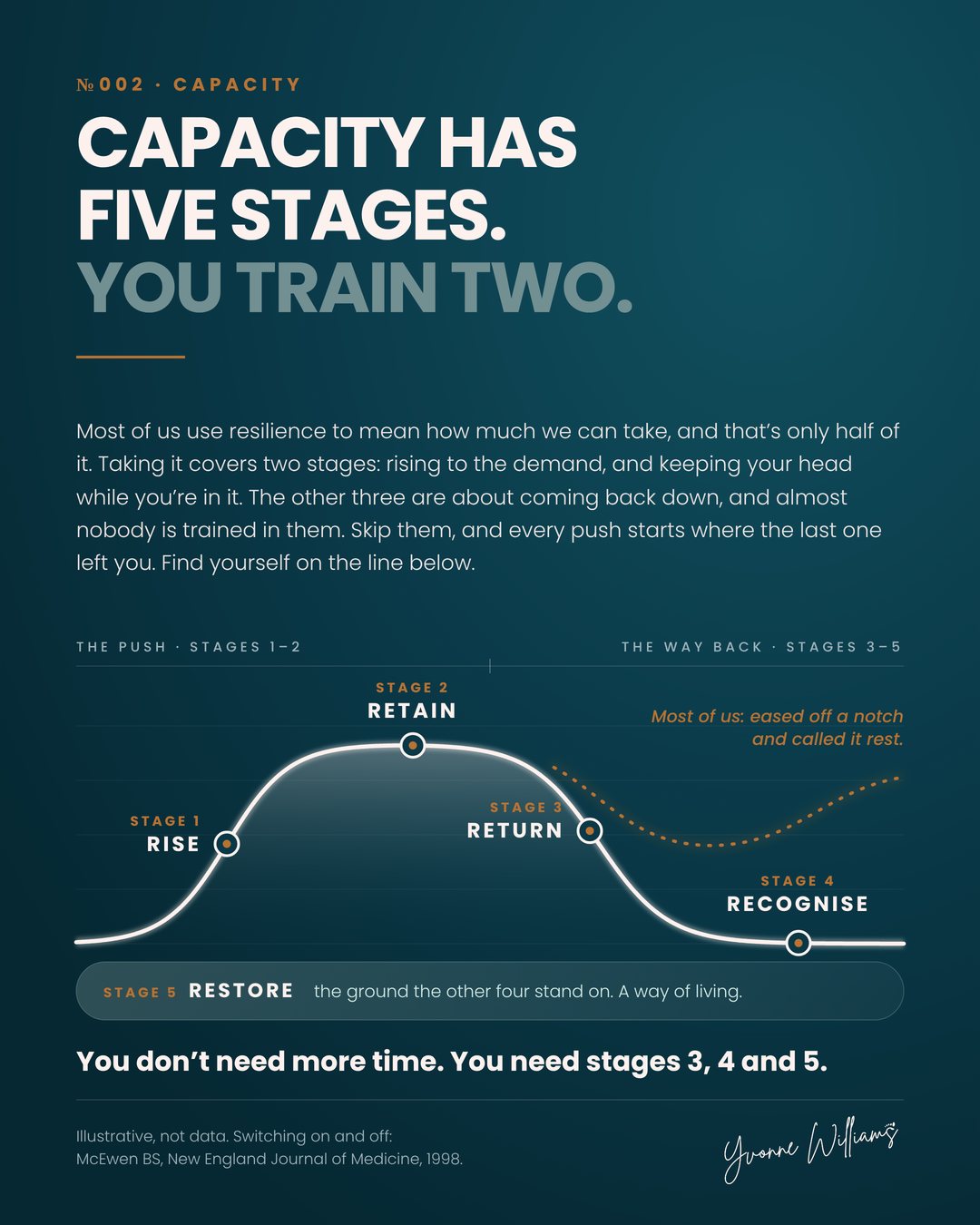
And you won’t find that out in your head. You’ll find it in your shoulders. The meeting ends at five. Your shoulders don’t. Your body is built to switch on when it’s needed and switch off when it’s over, and it’s the switching off that quietly stopped working years ago. You eased off a notch and called it rest. So you walk into the next thing still braced from the last one, and by Thursday you’ve got the time and nothing left to bring to it.
When the whole cycle works, there’s a name for it: calm velocity... Full pace when it counts. A clean way back when it’s done.
The good news is in the same research. What pressure does to that part of the brain reverses when the pressure eases. It comes back. It can be built.
You are not short of resilience. You are short of capacity.
Time can’t be built. Capacity can.
Next week, the question underneath all of this: what is it all for? Six thousand people were followed for fourteen years to find out what happens to the ones who can answer it.
Mind how you go.